Everyone has unlocked their phone with their face. Most people have watched Netflix recommend something based on what they just watched. A lot of us have driven past speed cameras, been tagged in a photo automatically, or used an app that reads a document just by pointing a camera at it.
All of that is computer vision.
And yet, if you ask most people what computer vision actually is, you get a blank stare. They've used it hundreds of times today without knowing its name. If you're learning AI seriously, that's a gap worth closing, because computer vision is one of the most deployed, most economically significant branches of AI in existence. Not a niche research topic. Not a future technology. Something running in production, at scale, right now.
This post explains what it is, how it works, and why it matters, without requiring a math degree to follow along.
What Is Computer Vision?
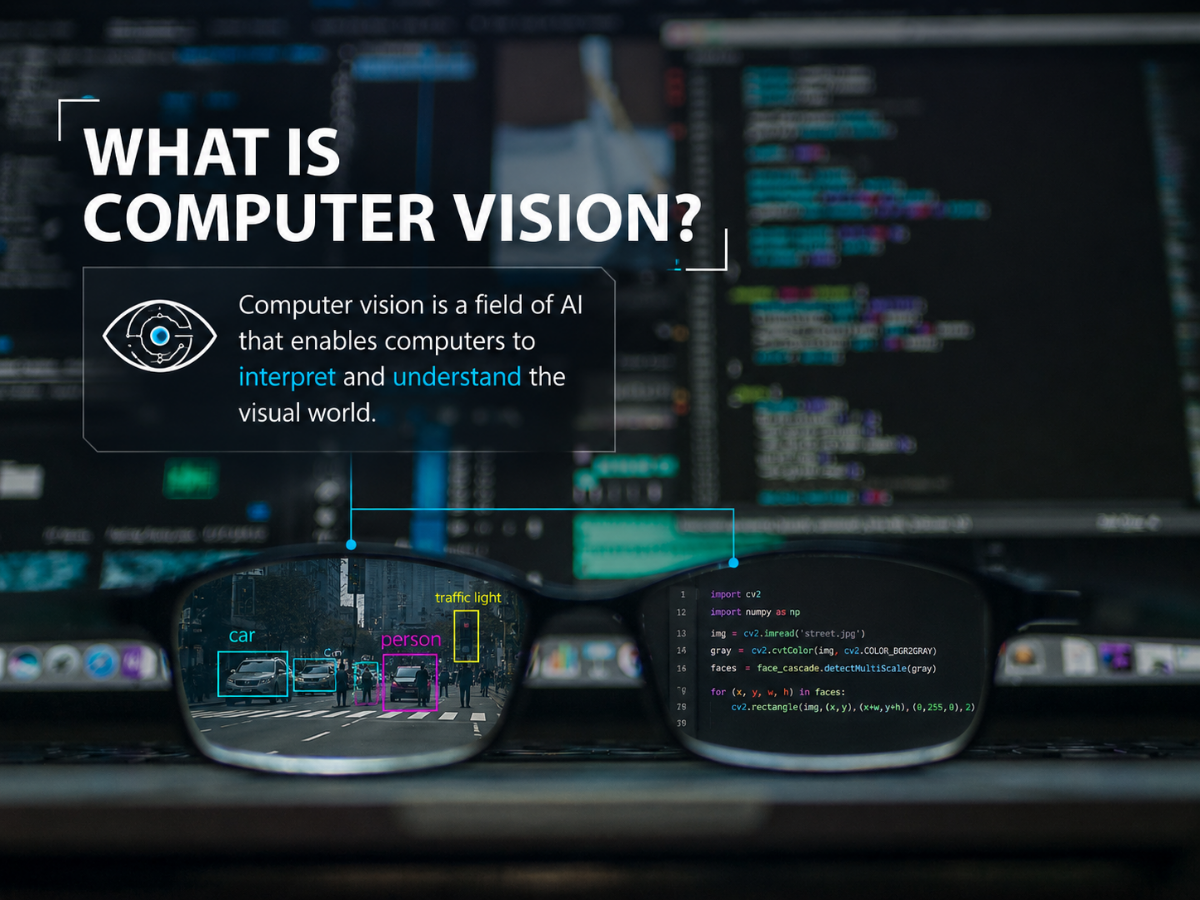
Computer vision is the field of AI that teaches machines to see and interpret visual information, images, video, and anything a camera can capture.
Break that down:
- Visual information: images, video frames, medical scans, satellite imagery, live camera feeds.
- See: not just receive pixels, but process them in a way that extracts meaning.
- Interpret: understand what's in the image, where things are, what's happening, and sometimes what should happen next.
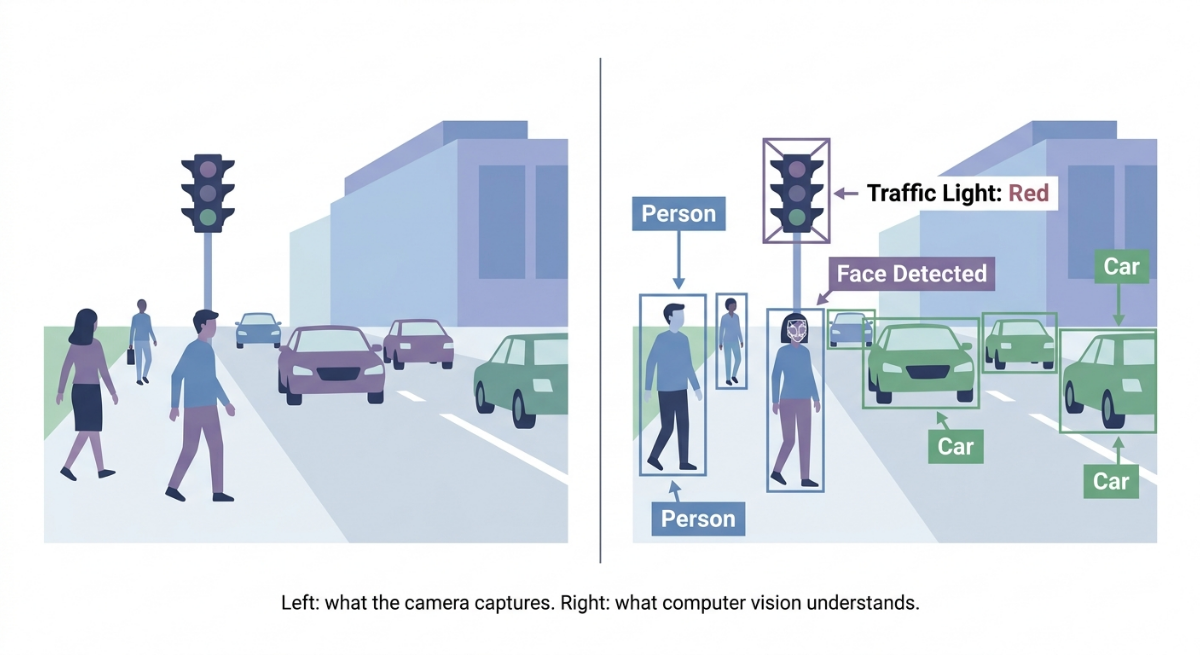
When your phone unlocks by recognizing your face, a computer vision model analyzed the geometry of your features and matched it against a stored reference. When a self-driving car detects a pedestrian, a computer vision model identified a human shape in a stream of video frames and calculated its position and trajectory. When a radiologist's AI assistant flags a suspicious region in an X-ray, a computer vision model found a pattern in pixel data that correlates with disease.
The common thread: a machine is making sense of the visual world, something that used to be exclusively human.
What Is Computer Vision in AI?
Computer vision sits inside the broader AI family, alongside natural language processing (which handles text and speech) and other branches focused on structured data, audio, and decision-making.
Here's how they relate:
| Term | What It Covers |
|---|---|
| AI (Artificial Intelligence) | The broad field of building machines that do intelligent things |
| Machine Learning (ML) | A subset of AI where machines learn from data rather than explicit rules |
| Deep Learning | A subset of ML using neural networks with many layers |
| Computer Vision (CV) | A subset of AI focused specifically on visual data |
Deep learning is what made modern computer vision possible. Before deep learning, computer vision relied on hand-crafted rules: detect edges here, look for corners there, match this pattern against a database. It worked for controlled conditions and broke down everywhere else.
Deep learning changed that. Instead of writing rules, you train a neural network on millions of labeled images and let it learn the visual patterns itself. The result was a dramatic leap in what machines could recognize, and how reliably they could do it in real-world conditions.
Important note: As we covered in the natural language processing (NLP) blog machine learning approaches were proven effective for it and deep learning aswell for harder cases. In the case of computer vision, not that many machine learning approaches are that effective since learning image representations is inherently a harder domain for a machine to learn. Deep learning was required to get that actual jump and AlexNet was the key breakthrough for it.
How Does Computer Vision Actually Work?
You don't need to write code to understand this. Here's what's happening under the hood.
Pixels Are the Raw Material
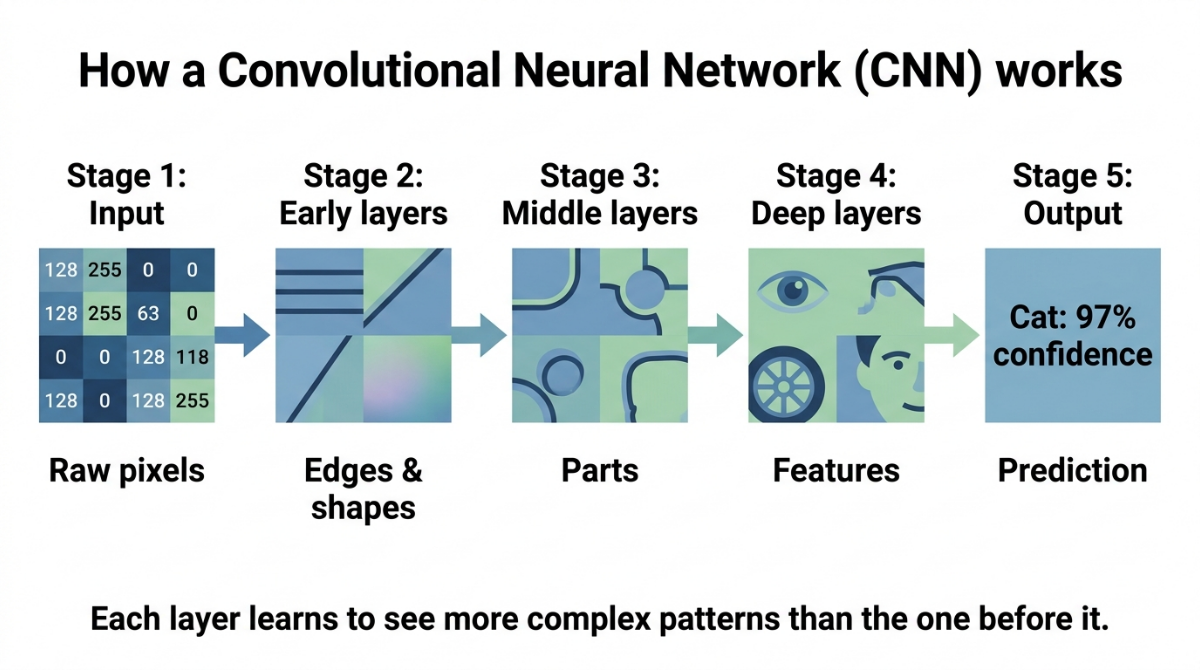
Every digital image is a grid of pixels. Each pixel has a numerical value representing its color. A grayscale image is a 2D grid of numbers from 0 (black) to 255 (white). A color image is three of those grids stacked together, one each for red, green, and blue.
That's what a computer vision model actually receives: a matrix of numbers. Not a photo of a cat. A grid of numbers that, if displayed correctly, looks like a photo of a cat.
The Model Learns to Find Patterns
A deep learning model for computer vision (most commonly a Convolutional Neural Network, or CNN) processes that grid of numbers through many layers. Early layers detect simple patterns: edges, gradients, basic shapes. Later layers combine those into complex patterns: eyes, wheels, faces, tumors.
The model doesn't know what an eye looks like when you start training it. It learns by seeing millions of labeled examples ("this image contains a cat," "this image does not") and adjusting its internal parameters until it gets reliably good at telling the difference.
The Model Produces an Output
Once trained, the model takes a new image it's never seen and produces an output. That output depends on the task: a label ("cat"), a bounding box around an object, a pixel-level map of what's where, or a prediction about what will happen next in a video.
The visible product is simple. The machinery behind it is anything but.
What Is Computer Vision Used For?
This is where the abstraction becomes real. Computer vision is not one application. It's a capability that underlies hundreds of them, across almost every industry.
Core CV Tasks (and Where You've Seen Them)
Image Classification: assigning a label to an entire image. Is this a cat or a dog? Does this chest X-ray show signs of pneumonia? The simplest CV task and still one of the most widely deployed.
Object Detection: finding and locating specific objects within an image, drawing a bounding box around each one. This is what self-driving cars use to find pedestrians, cyclists, and other vehicles in a camera feed in real time.
Image Segmentation: going beyond bounding boxes to identify exactly which pixels belong to which object. Used in medical imaging (outlining a tumor precisely), autonomous vehicles (understanding road vs. sidewalk vs. sky), and augmented reality.
Facial Recognition: identifying or verifying a person from their face. Used in phone unlocking, border control, security systems, and (controversially) public surveillance.
Optical Character Recognition (OCR): reading text from images. Scanning a document, reading a license plate, digitizing a handwritten form. OCR is one of the oldest computer vision applications and still one of the most economically useful.
Video Analysis: understanding what's happening across a sequence of frames, not just a single image. Detecting that someone fell in a warehouse. Counting how many cars passed through an intersection. Recognizing a specific action in sports footage.
Visual Search: finding visually similar items. Upload a photo of a chair you like, get back similar chairs for sale. Pinterest, Google Lens, and most major e-commerce platforms use this.
None of these require a frontier AI model. Many of them run on edge devices, embedded hardware, and systems that have been in production for years.
Computer Vision Across Industries
To make this concrete, here's where computer vision is doing serious work today:
Healthcare: detecting cancer in radiology scans, counting cells in pathology slides, monitoring patients in ICUs without requiring constant nurse presence. CV models in medical imaging now match or exceed specialist-level accuracy on specific diagnostic tasks.
Manufacturing: quality control at scale. Cameras on production lines inspect every unit for defects faster and more consistently than any human inspector. A scratch, a misaligned component, an incorrect label, CV catches it.
Agriculture: drones with cameras analyze crop health across thousands of acres, identifying disease, drought stress, or pest damage at the individual plant level. Farmers get maps of exactly where intervention is needed.
Retail: inventory management (cameras that detect empty shelves), loss prevention (identifying theft behavior), checkout-free stores (Amazon Go uses CV to track what customers take off shelves).
Construction and infrastructure: monitoring building sites for safety compliance, inspecting bridges and pipelines for structural damage using drone footage, tracking project progress against architectural plans.
Autonomous vehicles: every self-driving system in existence relies heavily on computer vision. Multiple cameras, often combined with radar and lidar, feed into CV models that understand the road environment in real time.
The pattern is consistent: anywhere there's a camera and a decision that used to require a human eye, computer vision is either already there or actively being deployed.
Computer Vision and Deep Learning: Why They're Inseparable
You'll often hear the terms computer vision and deep learning mentioned together. That's not a coincidence.
Before deep learning, computer vision was a field of hand-crafted feature engineering. Engineers would spend months designing algorithms to detect specific visual patterns. It worked in narrow, controlled conditions. It failed in the wild.
Deep learning for computer vision changed the equation. Instead of telling the model what to look for, you show it millions of labeled examples and let it figure out what matters. The breakthrough moment was 2012, when a deep learning model called AlexNet won the ImageNet competition by a margin that shocked the field. Error rates dropped from around 26% to 15% overnight. The game had changed.
Since then, the architectures have evolved dramatically. CNNs (Convolutional Neural Networks) became the standard for image tasks. Vision Transformers (ViTs) emerged as a powerful alternative, applying the same attention mechanisms that transformed NLP to visual data. Diffusion models learned to generate photorealistic images. Multimodal models like GPT-4o and Gemini combined vision and language, allowing models to describe images, answer questions about them, and reason across both.
The result is that computer vision and deep learning are now effectively synonymous in most production contexts. If you're working with images seriously, you're working with neural networks.
Computer Vision Python: The Ecosystem
Most computer vision work happens in Python. The core libraries you'll encounter:
- OpenCV: the workhorse. Image loading, manipulation, classical CV operations (edge detection, thresholding, contour finding), video processing. Been in production for decades. Still essential.
- Pillow (PIL): image handling and basic manipulation. The standard for loading and transforming images before feeding them to a model.
- PyTorch and TensorFlow: the two major deep learning frameworks. Most CV research and production work uses one of these as the backbone.
- Hugging Face: increasingly the standard for accessing pre-trained vision models, including Vision Transformers and multimodal models.
- Ultralytics (YOLO): if you need real-time object detection, YOLO (You Only Look Once) is the go-to. Ultralytics makes it accessible in a few lines of Python.
- torchvision: PyTorch's companion library for CV, with pre-trained models, standard datasets, and image transformation utilities.
You don't need to master all of these. OpenCV for image handling, PyTorch or TensorFlow for modeling, and a pre-trained model from Hugging Face or Ultralytics will take you through most practical projects.
Why Computer Vision Matters for AI Practitioners
There's a tendency to think of computer vision as a separate specialty, the domain of robotics engineers and medical imaging researchers. That's increasingly wrong.
Computer vision is showing up inside RAG pipelines (parsing visual documents), inside multimodal agents (models that can see and reason), inside data pipelines (extracting structured information from PDFs, forms, and screenshots), and inside evaluation systems (checking that generated content matches a visual reference).
If you're building AI systems in 2026, the probability that visual data touches your pipeline at some point is high and rising. Understanding what computer vision is, what it can do, and where its limits are, is no longer optional specialist knowledge. It's part of the foundation.
Key Takeaways
- Computer vision is the field of AI that teaches machines to interpret visual information, images, video, medical scans, camera feeds.
- It sits inside the AI family alongside NLP, and relies heavily on deep learning, specifically neural networks trained on large labeled image datasets.
- Core tasks include image classification, object detection, segmentation, facial recognition, OCR, and video analysis.
- Every major industry is either already using CV in production or actively deploying it: healthcare, manufacturing, agriculture, retail, construction, autonomous vehicles.
- The modern computer vision ecosystem is Python-based, with OpenCV, PyTorch, and Hugging Face as the core tools.
- Computer vision and deep learning are now effectively inseparable in production contexts. Understanding one means understanding the other.
Frequently Asked Questions

Javier Aguirre
Teaching AI from production reality, not hype.
Build your AI Foundations
Get the free checklist that production engineers use to avoid these common RAG pitfalls.
Get the Free Guide