There's a conversation that happens constantly in AI learning communities. Someone posts that they want to get into machine learning. Three replies in, someone drops a curriculum: linear algebra, multivariable calculus, probability theory, statistics, optimization theory. Twelve textbooks. Two years of prerequisites.
The person asking closes the tab and gives up.
Here's the honest version of that conversation: the math requirement for machine learning depends almost entirely on what you're trying to do with it. If you're doing research, pushing the boundaries of what models can do, yes, deep mathematical fluency matters. For everything else, like, building systems, applying models, and solving real problems with existing tools, the bar is significantly lower than most people claim.
This post is about that honest version. What math actually matters, what you can safely use without fully deriving, and where intuition is more important than calculation.
Disclaimer: Before we begin, some context. I've spent over a decade in AI, earned bachelor's and master's degrees in computer science, studied the full mathematical curriculum that people typically associate with machine learning (mathematical analysis, calculus, algebra, discrete mathematics, statistics...), published research papers, and deployed production AI systems used by real people.
I've seen machine learning from the classroom, the research lab, and the production environment. So when I say this, it comes from both theory and practice: much of what you've been told about the mathematics required for machine learning is either exaggerated, outdated, or aimed at a completely different audience.
This post is the version I wish someone had given me at the start. So, grab a coffee, we're going to challenge some assumptions.
Do You Need Math for Machine Learning?
Yes. But probably not in the way you think.
You don't need to be able to derive the backpropagation equations from scratch. You don't need to solve differential equations by hand. You don't need to prove convergence theorems. The overwhelming majority of practitioners never do any of that, even in senior roles at serious companies.
What you do need is mathematical intuition, the ability to understand what's happening inside a model well enough to reason about it, diagnose it when it fails, and make informed decisions about it. That's different from mathematical fluency. It requires less formal training and more conceptual understanding.
The analogy: you don't need to know how an internal combustion engine works to drive a car. But if you want to drive well, maintain it, diagnose problems, and make decisions about it (when does this noise mean something serious?), some understanding of what's happening under the hood genuinely helps.
Machine learning is the same. `from transformers import AutoModel` works fine without knowing how attention is computed. But when your model performs badly on a specific subset of inputs, or when you need to choose between two architectures, or when someone asks you why you made a particular design choice, the math is what gives you the vocabulary to answer.
What Is Machine Learning Maths, Really?
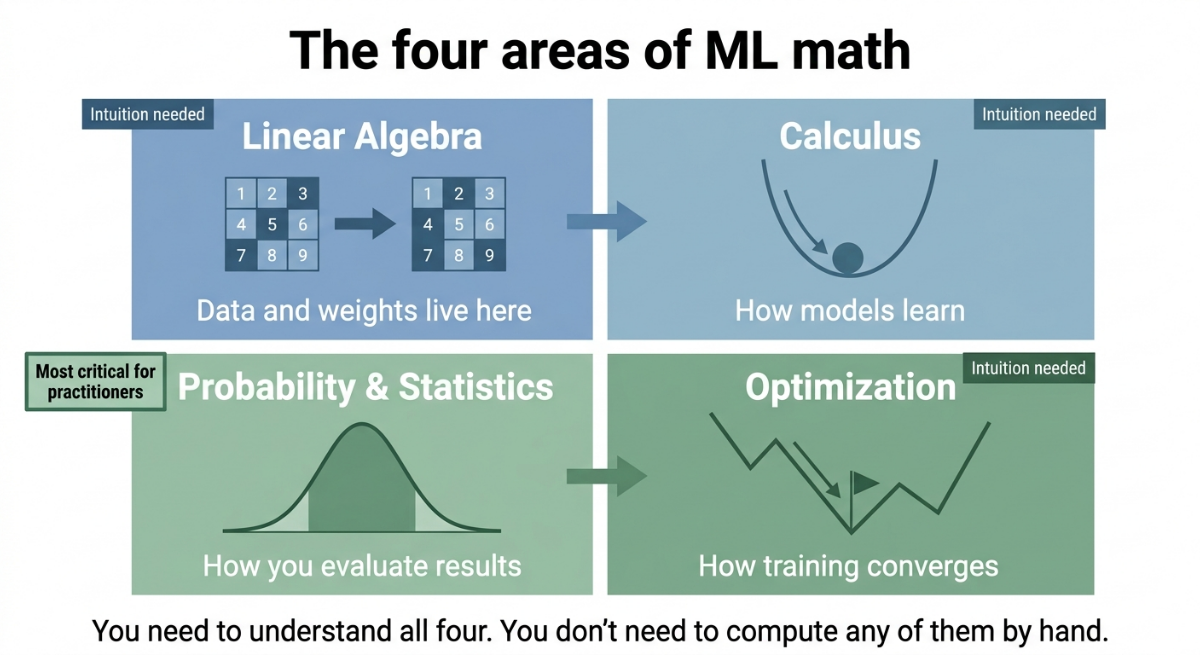
Machine learning draws on four areas of mathematics. Here's an honest assessment of each one:
1. Linear Algebra
What it is: the mathematics of vectors, matrices, and the operations between them.
Why it matters: nearly everything in machine learning is linear algebra under the hood. Data is stored as matrices. Model weights are matrices. The forward pass of a neural network is a sequence of matrix multiplications. Embeddings are vectors. Similarity between embeddings is computed as a dot product.
What you actually need to understand: - What a vector is (a list of numbers with direction and magnitude) - What a matrix is (a grid of numbers that transforms vectors) - What matrix multiplication does conceptually (combining transformations) - What dimensionality means (why a 768-dimensional embedding is what it is) - What dot products measure (similarity between vectors)
What you don't need: to perform matrix decompositions by hand, prove properties of linear transformations, or work through eigenvalue problems manually.
The honest take: linear algebra is the most important mathematical area for machine learning intuition. Not because you'll compute it manually, but because the entire mental model of how data flows through a model is geometric. If you understand vectors and transformations, a lot of ML behavior that seems mysterious starts making sense.
2. Calculus
What it is: the mathematics of rates of change and optimization.
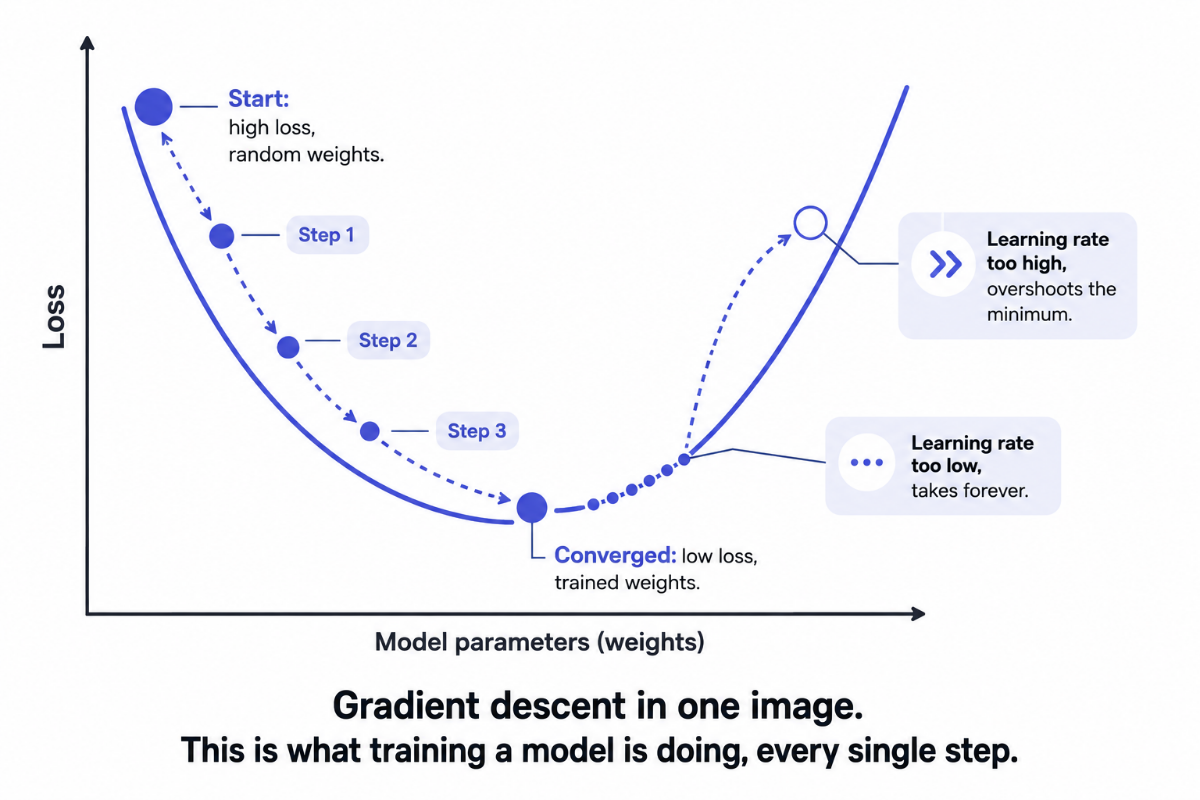
Why it matters: training a machine learning model means minimizing a loss function. The way that happens (gradient descent and its variants) is built on calculus. Backpropagation, the algorithm that trains neural networks, is an application of the chain rule.
What you actually need to understand: - What a derivative means conceptually (the slope of a function at a point, how much the output changes when you nudge the input) - What a gradient is (a derivative in multiple dimensions, pointing in the direction of steepest increase) - What gradient descent does (take small steps in the direction that reduces the loss) - Why learning rate matters (step size: too big and you overshoot, too small and you move too slowly)
What you don't need: to compute derivatives by hand, work through the full backpropagation derivation, or solve optimization problems analytically. PyTorch's autograd does all of that for you.
The honest take: understanding backpropagation conceptually (error flows backward through the network, each layer adjusts its weights based on how much it contributed to the error) is worth the effort. It helps you understand why deep networks are hard to train, what vanishing gradients are, and why techniques like residual connections and normalization layers exist. You don't need to perform a single derivative to get this intuition.
3. Probability and Statistics
What it is: the mathematics of uncertainty, distributions, and inference.
Why it matters: this is the area where the math most directly touches your day-to-day work as a practitioner. Model outputs are probabilities. Evaluation requires statistical understanding. Knowing whether your model actually improved or just got lucky on a test set is a statistics question.
What you actually need to understand: - What probability means (a number between 0 and 1 expressing how likely something is) - What a probability distribution is (how probability is spread across possible outcomes) - What the normal (Gaussian) distribution is and why it shows up everywhere - What mean, variance, and standard deviation measure - What conditional probability is (the probability of A given that B is true) - What precision, recall, and F1 mean, and which one to optimize for your specific problem - What overfitting and underfitting mean statistically (fitting the training data too closely vs. too loosely) - What a confidence interval is, and why "my model got 94% accuracy" requires context to be meaningful
What you don't need: to derive probability distributions from first principles, work through Bayesian inference calculations by hand, or prove statistical theorems.
The honest take: statistics is the area where skipping the math hurts you most in practice. You can use a model without understanding linear algebra intuitively. You can train a model without understanding calculus. But if you can't read your evaluation metrics correctly, you'll draw wrong conclusions from your results, ship models that don't actually work, and not notice when something has gone wrong. This is the math that pays off fastest.
4. Mathematical Optimization
What it is: the study of finding the minimum or maximum of functions.
Why it matters: training a model is an optimization problem. You're minimizing a loss function over millions of parameters. The algorithms used (SGD, Adam, AdaGrad) are optimization algorithms.
What you actually need to understand: - What a loss function is (a measure of how wrong your model is) - What a local vs. global minimum is (the model might get stuck in a good-enough solution rather than the best one) - What the main optimizers do differently (Adam adapts learning rates per parameter, which is why it's the default for most deep learning) - What batch size affects (larger batches are more stable but less generalizable, smaller batches add noise that can help escape local minima)
What you don't need: to derive optimizer update rules, prove convergence properties, or implement optimization algorithms from scratch.
How Much Math Do You Need? The Honest Map
Here's a practical breakdown based on what you're actually trying to do:
If you're applying pre-trained models (fine-tuning, prompt engineering, building on top of existing systems): statistics and basic probability are the priority. Understand your evaluation metrics. Understand what your model's confidence scores mean. Linear algebra intuition helps but isn't blocking.
If you're training models from scratch or fine-tuning seriously: add calculus intuition. Understand gradient descent, learning rate schedules, and why your loss curve looks the way it does. You still don't need to compute derivatives manually.
If you're designing architectures or doing research: now the full mathematical toolkit matters. You need to be able to read papers that use formal notation, derive properties of new methods, and reason rigorously about model behavior. This is a different job description than practitioner.
The mistake most beginners make is treating the researcher's math requirement as the practitioner's math requirement. They're not the same role.
The Case for Understanding Linear Regression
If there's one place to invest mathematical understanding as a beginner, it's linear regression.
Linear regression is simple enough to understand completely: you have inputs, you have outputs, you fit a line (or hyperplane) that minimizes the distance between your predictions and the true values. You can visualize every part of it. You can see what the weights mean. You can see what overfitting looks like. You can see what the loss function is doing.
Everything in machine learning is a generalization of this. Neural networks are stacked non-linear transformations that approximate much more complex functions, but the training logic is the same. If you understand linear regression deeply (not just how to call `LinearRegression().fit()`), you have the conceptual foundation to understand everything built on top of it.
This is true even though you'll almost never use linear regression directly in a production deep learning system. It's not about the algorithm. It's about building the intuition that carries forward.
Mathematics for Deep Learning: What Changes
Deep learning adds complexity to the math but doesn't change which areas matter.
The same four areas apply. What changes:
- Linear algebra: you're now dealing with tensors (matrices with more than two dimensions) rather than simple matrices. The intuitions are the same, the shapes are more complex.
- Calculus: backpropagation through many layers, vanishing and exploding gradients, the reason why activation functions like ReLU work better than sigmoid in deep networks. All calculus intuition, no hand calculation required.
- Statistics: larger models require more careful evaluation. Benchmark performance vs. real-world performance gaps become more pronounced. Statistical rigor matters more, not less.
- Optimization: deep learning introduced a whole zoo of optimizers and training tricks (learning rate warmup, gradient clipping, weight decay). Understanding what problem each one is solving is more important than knowing the math behind it.
The honest summary: mathematics for deep learning is the same foundation as mathematics for machine learning, applied to bigger, more complex systems. The intuition you build on the simpler cases transfers directly.
What to Actually Do
If you're worried your math isn't good enough, here's the practical path:
- Start building. The fear of math is almost always worse than the math itself. Get a model running. Look at what breaks. The math you actually need will become obvious from the problems you encounter.
- Learn statistics first. It pays off fastest and is the most directly connected to work you'll do every day.
- Get the linear algebra intuition. 3Blue1Brown's "Essence of Linear Algebra" series on YouTube is the best resource for this. No prerequisites required.
- Understand gradient descent conceptually before worrying about any other calculus. One concept, enormous payoff.
- Don't wait until you're "ready." There is no ready. The practitioners who know the most math got there by doing ML and picking up the math they needed along the way, not by completing prerequisites before touching code.
The mathematics for machine learning is learnable. It's also not a gate you have to pass through before you're allowed to start. Start, encounter the math in context, and learn it when it matters. That's how most practitioners who are good at both actually got there.
Key Takeaways
- You don't need to be a mathematician to do machine learning. You need mathematical intuition, understanding what's happening, not the ability to derive it from scratch.
- The four relevant areas are linear algebra, calculus, probability and statistics, and optimization. Statistics pays off fastest in day-to-day work.
- Understanding linear regression deeply is one of the highest-leverage investments a beginner can make. It's the conceptual foundation for everything else.
- Calculus for machine learning means understanding gradient descent and backpropagation conceptually. PyTorch handles the actual computation.
- Mathematics for deep learning is the same foundation applied to bigger systems. The intuition transfers.
- The researcher's math requirement and the practitioner's math requirement are not the same thing. Most people building real systems need far less than most curricula suggest.
Frequently Asked Questions

Javier Aguirre
Teaching AI from production reality, not hype.
Build your AI Foundations
Get the free checklist that production engineers use to avoid these common RAG pitfalls.
Get the Free Guide